If you spotted a small, yellow-throated bird skulking through marsh grass and want to know whether it's a common yellowthroat, and more importantly, whether it looks healthy or sick, you're in the right place. This guide walks you through identification, normal behavior, and then the specific signs that tell you something is medically wrong and what to do about it today.
Common Yellowthroat Bird ID and Illness Symptom Guide

Marcus Webb
23 Mar 2026
How to Identify the Common Yellowthroat (and Avoid Lookalikes)
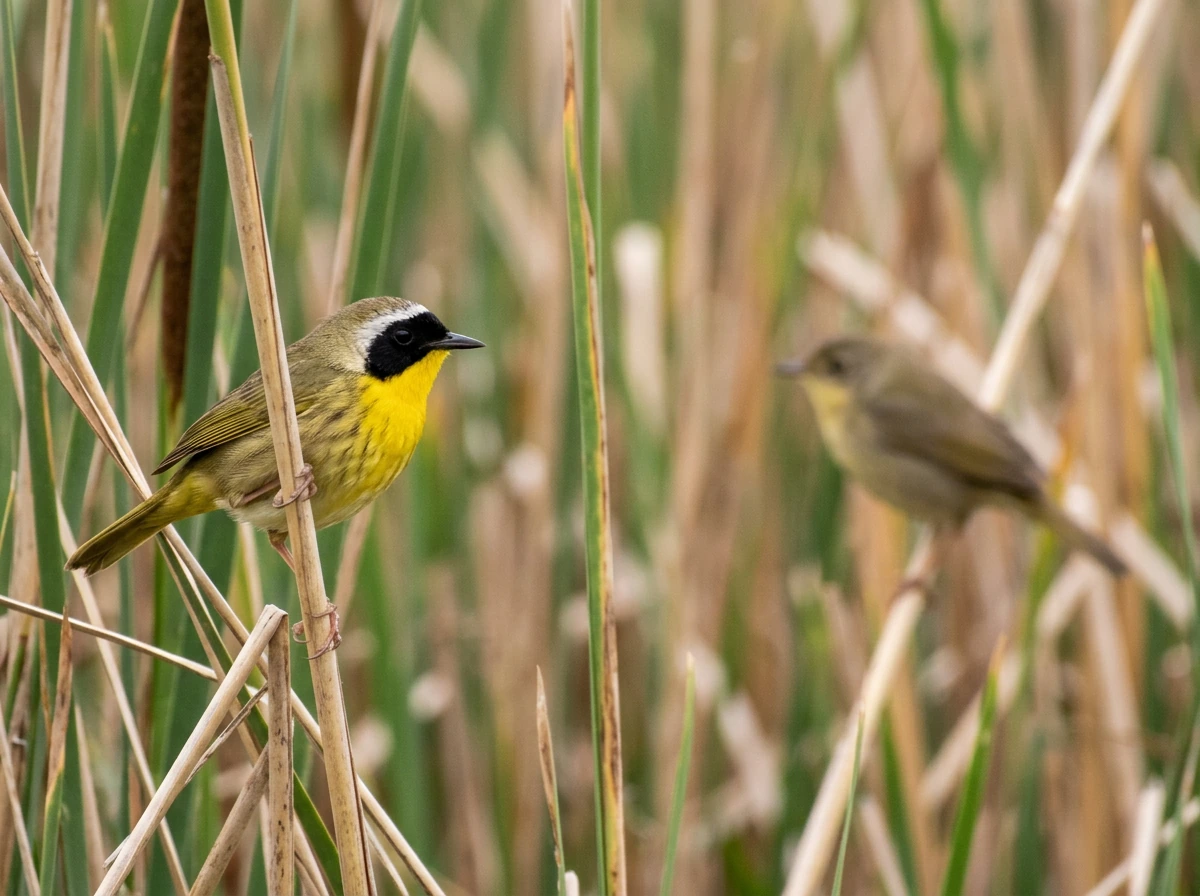
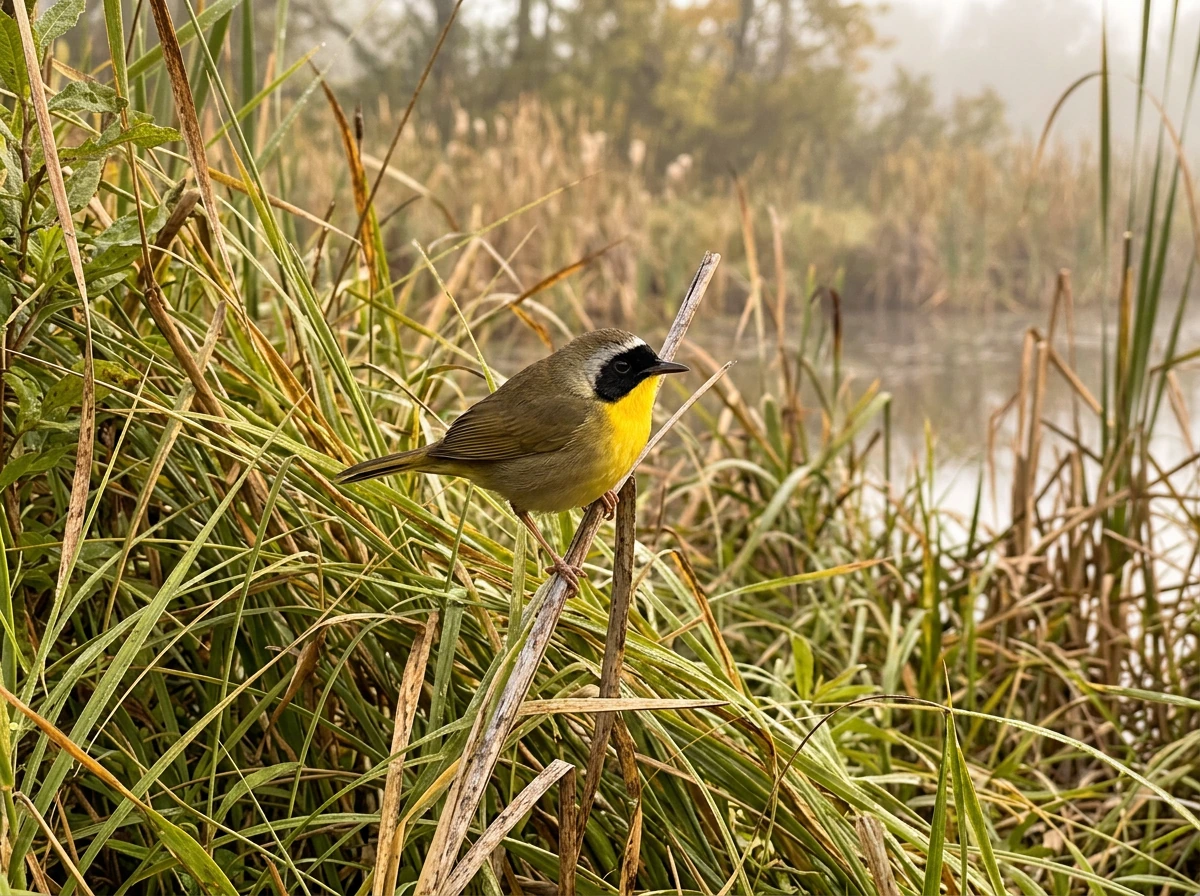
The common yellowthroat (Geothlypis trichas) is a small, chunky, rounded warbler with a short bill. The male is the easy one to spot: he wears a bold black facial mask that covers his forehead, wraps around his eyes, and extends across his cheeks. That mask is bordered above by a pale whitish band, and below it sits a bright, unmistakable yellow throat and breast. The rest of his body is olive-brown on the back and wings.
Females are trickier. They lack the black mask entirely, showing a plainer olive or brownish head, but they still have that yellow throat, just without the male's dramatic contrast. If you see a small, brownish-olive warbler with a yellow throat hiding in low, wet vegetation, a female common yellowthroat is a very reasonable guess.
One behavioral identification cue that works even before you get a good look at markings: common yellowthroats have a distinctive song that sounds like a repeating "wich-ity wich-ity wich-ity." If you hear that call coming from a wetland thicket, there's a good chance you've already found one.
The Two Main Lookalikes to Rule Out
Two birds regularly get confused with the common yellowthroat, and knowing the differences can save you a lot of uncertainty.
| Feature | Common Yellowthroat | Hooded Warbler | Yellow-Breasted Chat |
|---|---|---|---|
| Size | Small, compact warbler | Small warbler (similar size) | Noticeably larger, bulkier |
| Bill | Short, fine | Short, fine | Thick, heavy |
| Head/Mask pattern | Black mask across eyes/cheeks, pale border above | Full black hood surrounding yellow face | No mask; white eye stripe and cheek marks |
| Yellow extent | Yellow throat and upper breast | Yellow face framed by black hood | Yellow throat and breast, no wing bars |
| Tail | Short, typical warbler | White outer tail feathers (flashes when moving) | Noticeably long tail |
| Habitat overlap | Wet, open, low thickets | Forest understory, less wetland | Dense shrubby areas, forest edges |
The hooded warbler (Setophaga citrina) male has a yellow face that is framed by a black hood extending over the top and around the throat. That's the key difference: on a common yellowthroat, the yellow is below the mask and the mask sits across the eyes. On a hooded warbler, the yellow is inside the hood, not below it. Hooded warblers also flash white in their outer tail feathers when they fan their tails, something yellowthroats don't do.
The yellow-breasted chat (Icteria virens) is easier to separate because it's simply a bigger, heavier bird with a thick bill and a long tail. Chats have no white wing bars, and their overall bulk and behavior (louder, more secretive, less warbler-like) set them apart. If the bird looks almost too big and chunky to be a warbler, it's probably a chat, not a yellowthroat.
Common Yellowthroat Behavior and Habitat: What's Normal
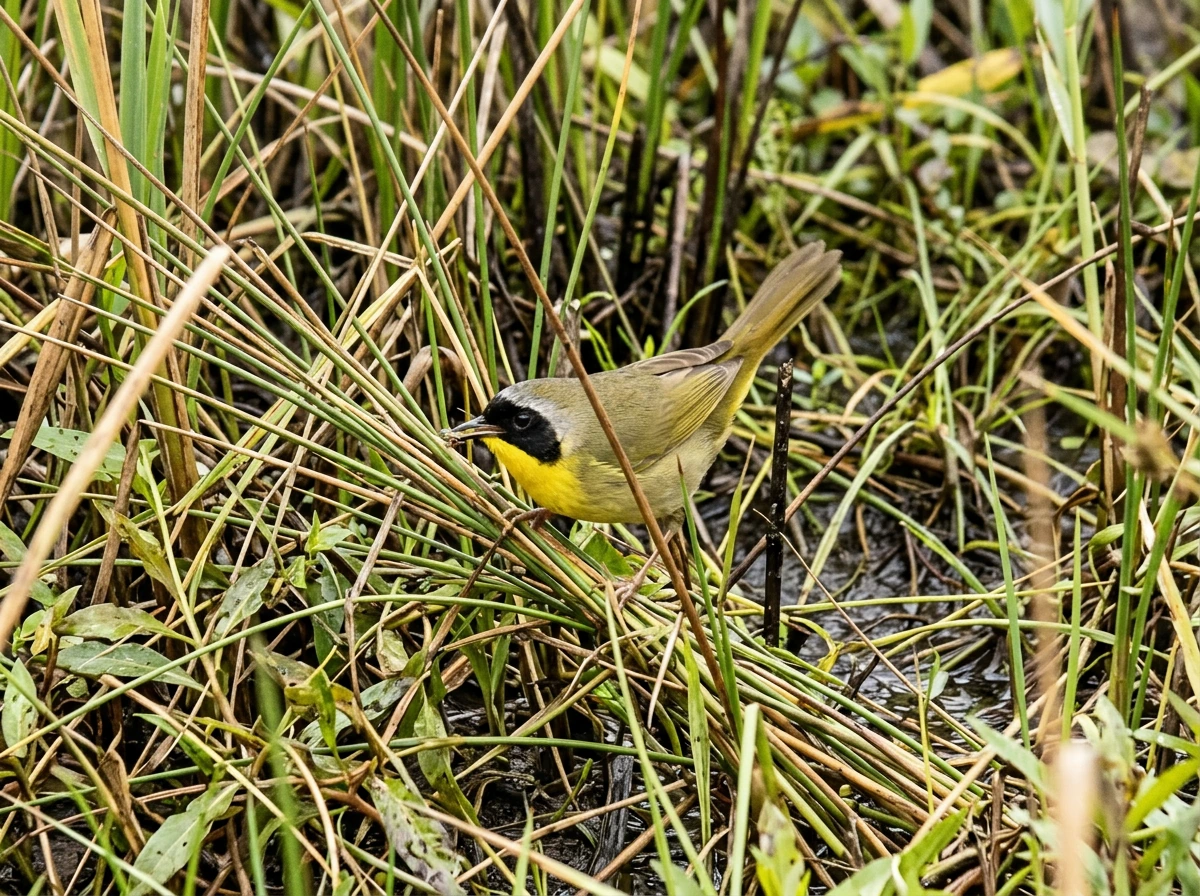
Common yellowthroats live in open areas with thick, low vegetation. Think marshes, wet prairies, moist grasslands, and dense shrubby thickets near ponds or streams. If you find one in the middle of a dry, open field or a dense forest interior, that's already slightly unusual, though birds do move through habitats during migration.
Breeding season runs roughly from early April through mid-July, with the peak activity from mid-May to early June. During this time, males are vocal and relatively visible as they defend territory. Outside breeding season, both sexes tend to be secretive and low in the vegetation.
Normal behavior for a common yellowthroat looks like this: the bird skulks low in thick bushes or marsh grass, pops up briefly, drops back down, moves quickly and with purpose, and flies short distances close to the ground. A <common thrush bird> reacts to your presence by moving away or disappearing into cover. common thrush bird That skittishness is a sign of health, not sickness.
What is not normal: a bird sitting on the ground or a low perch that doesn't flush when you approach, a bird that looks puffed up and still, or one that is breathing visibly with effort. Those are the signals that shift this from a simple ID question to a health concern worth acting on.
Signs of Illness in Common Yellowthroats
Small songbirds like common yellowthroats are good at hiding illness right up until they can't anymore, so if you're learning how to identify a thrush bird and notice red flags, treat it as a health concern worth acting on. If you’re also wondering what causes bird catcher spots on horses, that can be another sign of a problem worth addressing. By the time a wild bird looks sick to a casual observer, it's often already in significant distress. Here's what to look for, broken into respiratory signs and general illness indicators.
Respiratory Warning Signs
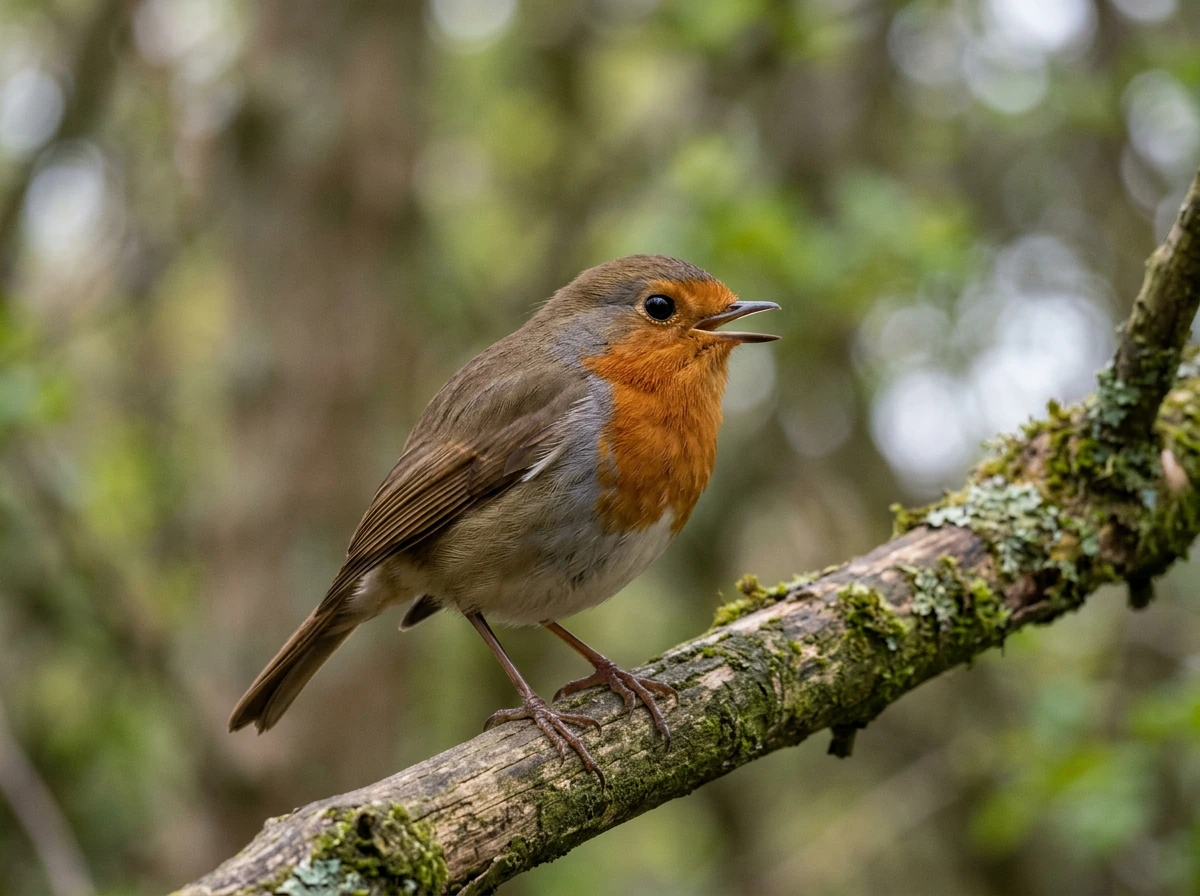
Respiratory distress is one of the most serious things you can observe in a wild bird, and it's visible if you know what to watch for. Open-mouth breathing at rest is the clearest red flag. A healthy bird at rest breathes with its beak closed. If the beak is open and the bird isn't singing or panting after flight, that's a respiratory emergency.
- Open-beak breathing while resting (not related to singing or recent exertion)
- Tail bobbing rhythmically with each breath (the whole body seems to pump with the effort of breathing)
- Increased sternal (chest) movement visible from the outside
- Wheezing, clicking, or rattling sounds with each breath
- Discharge from the nostrils or around the eyes
- Sneezing repeatedly or shaking the head as if trying to clear the airway
- Clogged or crusted nares (nostrils)
Tail bobbing is worth special attention because it's easy to miss. When a bird's respiratory system is struggling, the whole body gets recruited to help breathe. You'll see the tail dipping down and up with every breath, sometimes quite dramatically. Tail bobbing is worth special attention because it's easy to miss.
General Illness Indicators
- Fluffed or puffed-up feathers (especially when not cold, wet, or sleeping)
- Lethargy or extreme stillness, not fleeing when approached
- Inability to fly or only able to flutter short distances
- Sitting on the ground without attempting to escape
- Watery or swollen eyes
- Abnormal droppings (very watery, bloody, green, or absent)
- Visible wounds, bleeding, asymmetric wing position, or swollen limbs
- Visible parasites like feather lice (small moving specks on the feathers)
- Head tilting, circling, or loss of coordination
Frequent Bird Illnesses That Show Up in This Species
Common yellowthroats are small passerines (perching songbirds), and the disease categories that affect songbirds generally apply here. You won't always be able to pin down a specific diagnosis just by watching, but you can narrow things down to a likely category, which helps when you're describing what you're seeing to a wildlife rehabilitator or avian vet.
Respiratory Infections and Air Sac Disease
Airsacculitis, an inflammation of the air sacs that birds use instead of lungs the way mammals do, is a recognized disease category in songbirds. Signs include difficult or labored breathing, coughing, ruffled feathers, loss of appetite, watery eyes, nasal discharge, and lethargy. If you're seeing a bird that's puffed up and breathing with effort, an infection affecting the respiratory system is a strong possibility. Some respiratory infections also produce wet, mucus-filled lesions in the mouth or throat, visible as white or yellowish plaques inside the beak.
External Parasites
Feather lice are common in wild songbirds and are sometimes found in birds that come into wildlife rehab. They aren't always a primary emergency, but heavy parasite loads can stress a bird that is already ill or injured. Look for tiny moving specks among the feathers, or feathers that look chewed or ragged without obvious injury. This is something rehab staff will assess and treat, not something you should try to address yourself.
Trauma and Injuries
Window strikes, cat attacks, and collisions are common causes of injury in small songbirds. Signs include a bird that is grounded but alert, or one that's visibly bleeding, holding a wing at an odd angle, or has a visible wound. Cat puncture wounds are particularly serious even if they look minor, because cats carry bacteria that can cause fatal infection in birds within hours. For example, the American Red Cross says cat bite wounds can look minor but may become infected, so you should have them evaluated by a veterinarian as soon as possible. Any bird that has been in a cat's mouth needs professional evaluation the same day.
Starvation and Dehydration
A bird that is extremely thin (you can feel the keel bone protruding sharply when you gently hold it), lethargic, and has sunken eyes may be suffering from starvation or dehydration. This is a medical emergency requiring professional support, not a situation where well-meaning feeding at home will help safely.
Neurological and Toxicity Issues
A bird circling in place, tilting its head, falling over, or showing tremors may have a neurological issue from a head injury, infection, or toxin exposure (pesticide ingestion is not rare in small insect-eating birds like yellowthroats). These birds need urgent professional care and are not candidates for a wait-and-see approach.
When to Get Veterinary Help or Contact Wildlife Rehab
Here's a straightforward decision guide. This is not a situation where you need to tick every box. Any single red-flag symptom is enough reason to act.
Contact a wildlife rehabilitator or avian vet immediately if you observe any of the following:
- Open-beak breathing at rest
- Tail bobbing with every breath
- Wheezing, clicking, or gurgling sounds while breathing
- Discharge from the eyes or nostrils
- The bird has been in a cat's mouth (even without visible wounds)
- Visible bleeding, broken bones, or deformity
- Puncture wounds, maggots, or fly eggs visible on the bird
- Head tilting, circling, tremors, or inability to perch
- The bird is grounded and makes no attempt to escape when you approach closely
- Obvious inability to fly (not just reluctance)
If the bird was grounded after a window strike but is alert and upright, you can give it 30 to 60 minutes in a quiet, dark, ventilated box to recover. Window-stunned birds often recover fully if kept safe from predators and given time. But if it doesn't recover within that window, or if breathing is labored at any point, that's the signal to escalate to rehab.
To find a licensed wildlife rehabilitator near you, contact your state's fish and wildlife agency or search the National Wildlife Rehabilitators Association directory online. Most areas also have local Audubon chapters or bird banding stations that can direct you to the right contacts quickly.
Basic First Aid and Safe Steps While You Observe or Transport
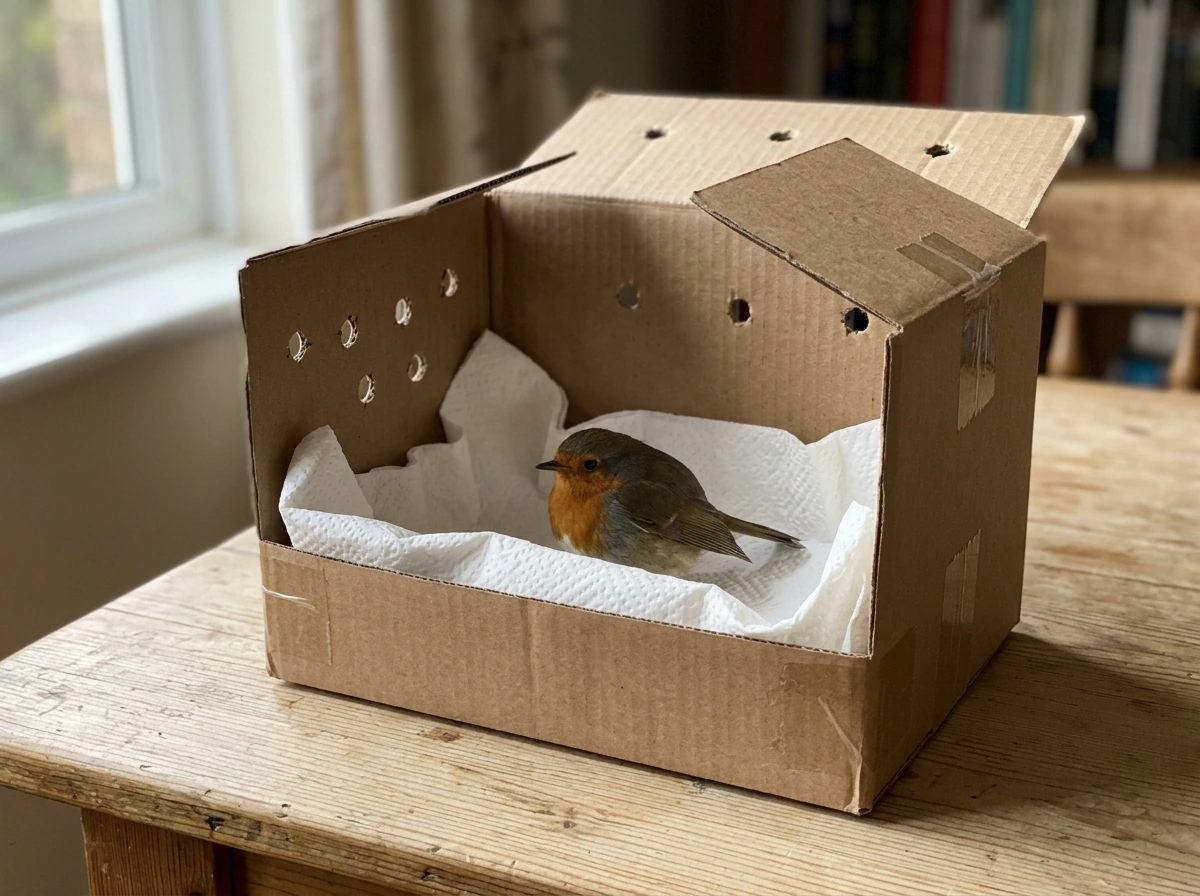
If you have a sick or injured common yellowthroat in front of you and you're waiting to reach a rehabilitator, here's what to do and, just as importantly, what not to do.
What to Do
- Contain the bird gently in a small cardboard box or paper bag with air holes. Line it with a soft cloth or paper towel. The container should be small enough that the bird can't thrash around and injure itself further.
- Keep it warm. Place the box in a warm, quiet area, ideally around 85 to 90 degrees Fahrenheit for a stressed bird. You can put half the box on a heating pad set to low so the bird can move to a cooler corner if it gets too warm. Cover the box completely to keep it dark.
- Keep it quiet. Minimize handling and talking near the box. Stress is a genuine health risk for small songbirds and can be fatal on its own.
- Contact a wildlife rehabilitator as soon as possible. The faster you get professional guidance, the better the outcome.
What Not to Do
- Do not offer food or water. This is the most important rule. Water can spill onto the bird's feathers, soaking them and causing dangerous chilling or hypothermia. Food given incorrectly can cause choking or aspiration. Wildlife rehab professionals are firm on this: no food or water until you've spoken with a trained rehabilitator.
- Do not try to force the beak open to give water or medication.
- Do not place the bird in a cage with wire mesh it can injure its beak and feathers on.
- Do not leave the box in direct sunlight or a hot car, which can cause heat stroke within minutes.
- Do not handle the bird more than necessary. Even gentle, well-meaning handling causes enormous stress in wild birds.
- Do not attempt to splint broken bones or treat wounds yourself.
If overheating becomes a concern (the bird is open-mouth breathing and the box is very warm), move it to a cooler spot and make sure the box has adequate ventilation without drafts. A bird that is too hot will open its mouth and stretch its neck, which can look similar to respiratory distress from illness. Context and temperature check make it easier to distinguish the two.
The bottom line: your job during the waiting period is to reduce stress, maintain safe warmth, keep things dark and quiet, and get professional help on the phone as quickly as possible. You don't need to diagnose the bird. You need to keep it stable and get it to someone who can.
FAQ
If I find a common yellowthroat on the ground, how long should I wait before calling for help?
Yes. A grounded common yellowthroat that is upright, alert, and breathing quietly can sometimes recover if you keep it in a dark, quiet, ventilated container for 30 to 60 minutes. If it stays puffed up, is breathing with visible effort, has an open mouth at rest, or shows no improvement in that time window, treat it as a medical emergency and contact a rehabilitator the same day.
Can I feed or give water to a sick common yellowthroat while I wait for a rehabilitator?
Avoid feeding or giving water by hand. Tiny passerines can aspirate liquids, and many home foods are nutritionally wrong and can worsen dehydration or gut issues. If the bird must be held briefly, focus on warmth, darkness, and ventilation only, then get professional guidance from a wildlife rehabilitator.
What is the safest way to keep a common yellowthroat stable while waiting for a call back?
Use a secure, escape-proof box or carrier with breathable ventilation, and add soft, clean paper towels for non-slip footing. Keep the bird warm but not hot (no heating pads, no direct sun). Drafts, loud noise, and handling can increase stress and worsen breathing.
If the bird seems responsive, can it still be seriously ill?
Open-mouth breathing at rest, especially with tail bobbing, is a stronger emergency sign than whether the bird is on the ground. A bird can look “tolerable” while actively struggling internally, so prioritize breathing quality over how responsive it seems.
How can I tell overheating from illness in a common yellowthroat that has an open beak?
Context matters. Overheating can cause open-mouth breathing and neck stretching, and chilled birds can look puffed up. If you suspect temperature stress, move the container to a cooler spot with gentle airflow and reassess within minutes. If breathing remains labored, escalate to professional help immediately.
What should I do (and avoid) when I need to pick up a grounded common yellowthroat?
Common yellowthroats are small, so you can reduce the risk of bites and injury by minimizing handling. If you must move it, use a towel to gently contain the body, support the feet, and avoid squeezing the chest or abdomen. For serious injuries or any cat-related trauma, do not attempt on-the-spot first aid beyond keeping it secure.
If a cat might have attacked the bird but there is no obvious wound, should I still worry?
Yes. Even a small puncture from a cat can progress quickly due to bacteria, and the wound may look minor from the outside. Any cat attack, including a “play bite,” is a same-day professional-evaluation situation.
Is tail bobbing always a sign of respiratory trouble?
Tail bobbing is a helpful clue, but it can be mimicked by certain behaviors like walking fast or reacting to disturbance. The key difference is rhythmic, repeatable movements that match each breath, especially when the bird looks puffed up, has open-mouth breathing, or is otherwise unable to settle.
Are feather lice in a common yellowthroat always an emergency?
Yes. Heavy feather lice are often a sign of another problem or can make a stressed bird weaker, but they are rarely the only “urgent” finding. If lice are present along with labored breathing, bleeding, inability to perch, or severe lethargy, treat the overall condition as urgent and let rehab staff handle parasite treatment safely.
What details should I collect for a wildlife rehabilitator when reporting a sick common yellowthroat?
A quick photo checklist can help rehab staff decide how urgent it is. Include the bird breathing posture (beak open or closed at rest), body position (puffed up or normal), any visible discharge or plaques in the beak, wing position (if held oddly), and whether there is blood or an obvious wound. Capture the container temperature and the bird’s behavior before you handle it.
Should I keep my pets away from the area if I’m trying to help a common yellowthroat?
In most cases, the safest choice is to keep pets indoors and away from the bird, since dogs and cats can cause repeat injury and increase infection risk. Even “gentle” curiosity can cause stress, collisions, or new bites.
Next Article
What Causes Bird Catcher Spots on Horses and What to Do
Learn what causes bird catcher spots on horses, how to triage itchy lesions, and when to see a vet for treatment.