Yes, hummingbirds can be affected by bird diseases, and the one most likely to show up at your feeder is avian pox. Bird viruses can spread through contact with infected birds, contaminated feeders, water, or insects like mosquitoes. Bird flu (avian influenza) is a much lower risk for hummingbirds specifically, but it's worth understanding both so you know what you're actually dealing with. If you are wondering what a fever bird is, it usually refers to a bird showing signs of illness that may be linked to infections what is a fever bird. If you're seeing a sick or odd-looking hummingbird right now, the practical steps are the same regardless: stop feeding temporarily, clean your feeders thoroughly, and watch for the specific warning signs below.
Are Hummingbirds Affected by the Bird Disease? Symptoms

Which "bird disease" are we actually talking about?
The phrase "the bird disease" gets used loosely online, and it usually refers to one of a few different things depending on the season and what's making headlines. For a deeper overview of what bird disease is, including the most common culprits behind hummingbird symptoms, see this guide on what is bird disease. The main candidates are avian influenza (bird flu), avian pox, salmonellosis, and occasionally psittacosis (parrot fever). Each one spreads differently, affects different species differently, and has different implications for your hummingbirds and your feeders.
Avian influenza is the disease that gets the most news coverage. If your real question is why bird flu is given that name, see why was bird fever named so as a related naming and history note. It's caused by influenza type A viruses and circulates primarily among waterfowl, shorebirds, and waterbirds. The Iowa DNR and NYC Department of Health both note that feeder birds, including songbirds and hummingbirds, do not commonly carry bird flu the way waterfowl do. For the latest on bird disease outbreaks, it can help to also check the latest on bird disease, since local monitoring updates what risks are currently active bird flu risk for hummingbirds. If you are wondering, “is the fever bird real,” the answer depends on what people mean by that phrase and which specific disease is actually being discussed. Unless ducks or geese are sharing your yard, the bird flu risk for hummingbirds is genuinely low.
Avian pox is the far more likely culprit when hummingbirds look sick at feeders. It's caused by Avipoxvirus, it's documented in hummingbirds specifically (including a confirmed laboratory-diagnosed case in an Anna's hummingbird in California), and it spreads through feeder contact and biting insects. This is the disease to focus on if you're seeing visible lesions or behavioral changes in your hummingbirds.
Salmonellosis is linked to songbird outbreaks, especially at seed feeders, and is worth knowing about if you also maintain seed or suet feeders alongside nectar feeders. UC Davis School of Veterinary Medicine explains salmonellosis is an infection caused by Salmonella bacteria in wild songbirds and notes it can be tied to outbreaks that lead to songbird deaths, consistent with California Department of Fish and Wildlife outbreak reporting Salmonellosis is linked to songbird outbreaks, especially at seed feeders. Psittacosis matters more in parrot and pigeon contexts but can occasionally affect a wider range of birds through inhalation of contaminated dust or feathers. Matching your observation to the right disease is more useful than treating every situation as a generic "bird disease" emergency.
Can hummingbirds actually get it? Susceptibility and how disease spreads to them
Hummingbirds are susceptible to avian pox, and the data backs this up more firmly than many people expect. Research has found avian pox prevalence in hummingbirds ranging from about 0.5% to 12% in areas where the virus has been present longer, and up to 86% in areas where hummingbirds have had more recent exposure (such as island populations). That wide range tells you the risk is real but variable depending on your location and the local bird population.
Transmission happens in two main ways. The first is direct contact: the virus enters through skin breaks or mucous membranes, so a hummingbird that visits a feeder perch where an infected bird left secretions can pick it up. The second route is mosquitoes. Cornell notes that mosquitoes can carry avipoxvirus on their mouthparts and transmit it from bird to bird during feeding, which means feeder hygiene alone can't fully eliminate the risk during mosquito season.
Cornell also points out that birds can become infected indirectly through contact with contaminated feeders, water, and even dust. This is why feeder density matters. The more birds that crowd around a single feeder, the faster a localized outbreak can move through your yard visitors. For hummingbirds, which can get territorial and aggressive around nectar feeders, that close-contact dynamic is real.
For bird flu, the risk to hummingbirds is low under normal backyard conditions. The virus circulates in waterfowl, and hummingbirds don't share habitat or food sources with ducks and geese the way some feeder birds do. That said, if you're in a migratory corridor or near open water where infected waterfowl are present, basic hygiene precautions still apply.
What to watch for: hummingbird warning signs and symptom patterns
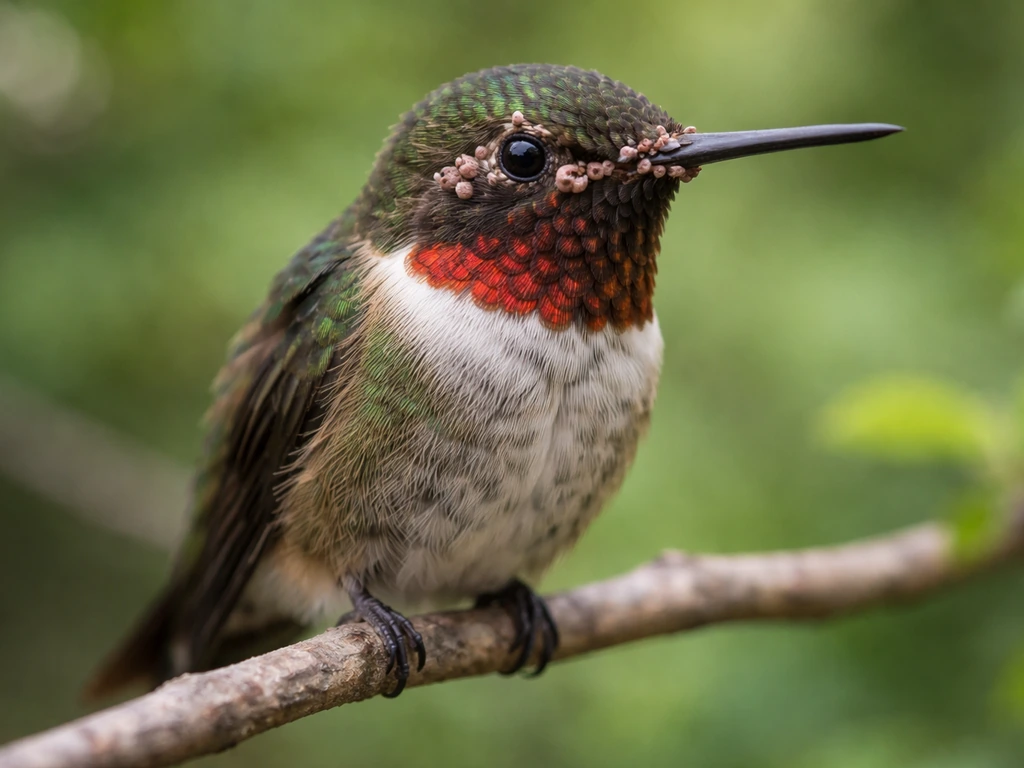
Avian pox in hummingbirds produces visible, physical lesions. The classic signs are wart-like growths, typically appearing at the base of the beak, around the eyes, and on areas of bare skin. These aren't subtle once you know what you're looking for. In the wet (internal) form of avian pox, lesions can develop inside the mouth and respiratory tract, which makes breathing and feeding harder. BC Government wildlife guidance lists difficulty seeing, breathing, feeding, and perching as hallmarks of severe avian pox cases.
Beyond visible lesions, watch for behavioral changes. A hummingbird sitting unusually still, fluffed up, or hovering weakly near a feeder is showing stress signals. Hummingbirds that miss the feeder port repeatedly or seem disoriented may have lesions affecting their vision. Any bird that allows you to approach closely without fleeing is almost certainly unwell.
Here's a practical checklist of warning signs to run through when you spot a hummingbird that concerns you:
- Wart-like or crusty growths near the beak, eyes, or feet
- Swollen or closed eyes
- Labored, open-mouth breathing or audible respiratory sounds
- Lethargy, sitting on a branch or the ground without fleeing
- Fluffed feathers held for extended periods
- Weak or erratic hovering at the feeder
- Missing the feeder port repeatedly (may indicate impaired vision)
- Visible discharge from the nostrils or eyes
- Significant weight loss (visible keel bone or skeletal prominence)
How this looks different from other birds, and where people get confused
Avian pox lesions in hummingbirds are often mistaken for injury, especially around the beak. Because hummingbirds are fast and territorial, feeder keepers sometimes assume a swollen area near the eye or beak base is a collision wound. The key difference is that injuries tend to show bruising, torn feathers, or asymmetric trauma, while pox lesions are rounder, wartier, and often bilateral (appearing on both sides).
In larger feeder birds like finches and sparrows, avian pox lesions are often easier to spot because the birds are bigger and slower to move. In hummingbirds, the fast movement and small size mean you might only catch a glimpse. Salmonellosis, which more commonly shows up in ground-feeding songbirds at seed feeders, tends to present with general lethargy and GI distress rather than visible external lesions, so if your hummingbird has lumps or growths, pox is the more likely explanation.
Bird flu in wild birds often causes sudden death, neurological signs (loss of coordination, head tremors, seizures), or severe respiratory distress. If a hummingbird is showing neurological symptoms and you're in an area with active HPAI circulation among waterfowl, that changes the urgency level. Cornell's HPAI guidance for wildlife rehabilitators notes that birds with clinical signs suggestive of HPAI and no obvious trauma or toxicity cause should be treated as potential HPAI cases.
| Disease | Most common visible signs | Species most affected | Feeder link |
|---|---|---|---|
| Avian pox | Wart-like lesions near beak, eyes, feet; breathing difficulty in wet form | Wide range including hummingbirds | Strong: spreads via contaminated perches and surfaces |
| Avian influenza (HPAI) | Sudden death, neurological signs, severe respiratory distress | Waterfowl primarily; feeder birds rarely | Low: mainly a risk if waterfowl visit feeders |
| Salmonellosis | Lethargy, GI distress, sudden death in songbirds; no external lesions | Ground-feeding songbirds at seed feeders | Moderate: spreads via fecal contamination of seed/water |
| Psittacosis | Respiratory signs, nasal discharge, lethargy | Parrots, pigeons; less common in hummingbirds | Low for hummingbirds specifically |
What to do right now: isolate, stop feeding, and clean safely
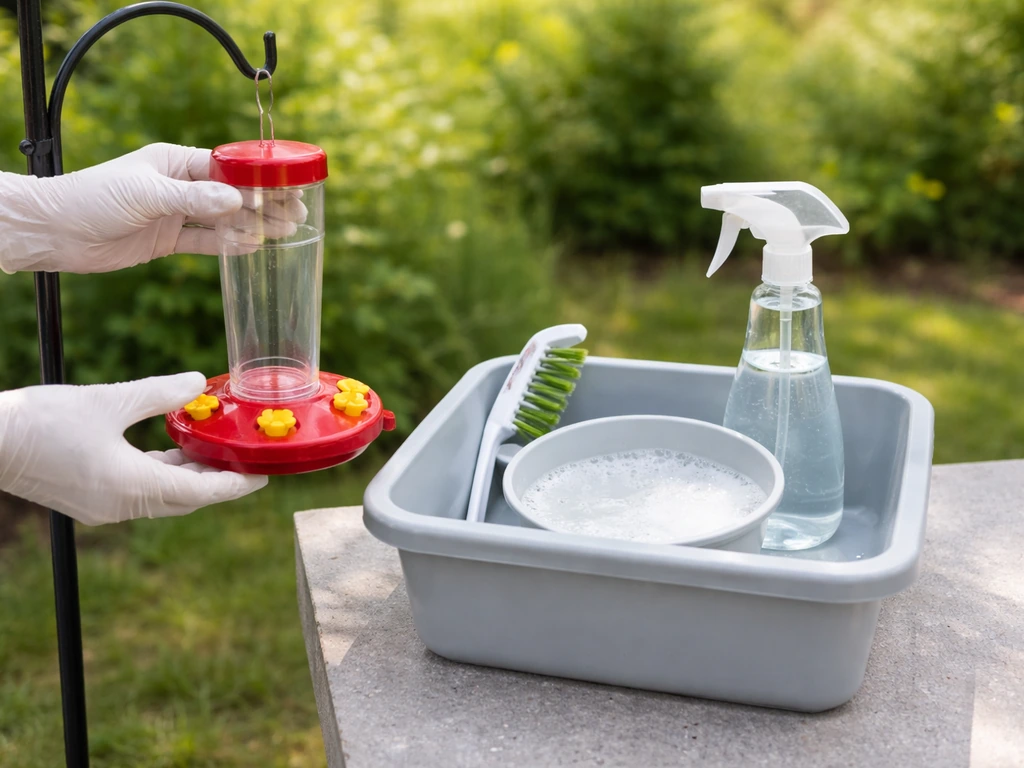
If you see a sick hummingbird at your feeder, the first step is to take the feeder down. Missouri DNR recommends stopping artificial feeding for several days when you suspect avian pox, and Iowa DNR advises removing feeders for at least two weeks if sick birds are present. This sounds harsh, but reducing bird congregation is one of the most effective ways to slow spread.
When you remove and clean the feeder, wear disposable gloves. The CDC specifically advises this for anyone cleaning feeders around potentially sick birds. Don't touch your face, and wash your hands thoroughly afterward even if you wore gloves.
For cleaning the feeder itself, you have two solid options. The first is hot water with dish soap, followed by a thorough rinse. The second, and more effective for disinfection, is a 10% bleach solution (roughly 1 part household bleach to 9 parts water). Both Iowa DNR and Missouri DNR recommend this concentration. Project FeederWatch suggests soaking feeder parts for about 10 minutes in a diluted bleach solution, then rinsing thoroughly before refilling. A weak vinegar solution is an alternative if you prefer to avoid bleach.
- Put on disposable gloves before touching the feeder
- Remove the feeder and discard all remaining nectar
- Disassemble the feeder completely
- Soak all parts in a 10% bleach solution for 10 minutes
- Scrub with a dedicated brush (not one used for food prep)
- Rinse all parts thoroughly under running water
- Allow to dry completely before reassembling
- Keep the feeder down for at least two weeks if sick birds were seen
- Wash your hands thoroughly even after removing gloves
- Bag and dispose of any debris or old nectar without spreading it
If you witnessed the sick bird up close and it's now on the ground or unable to fly, don't handle it barehanded. Use gloves or a cloth barrier if you need to move it to a safe spot out of reach of cats or other predators while you arrange help.
Red flags: when to call a vet or wildlife rehabilitator
Some situations call for more than feeder cleaning. Contact a licensed wildlife rehabilitator or avian vet if you see any of the following:
- A hummingbird on the ground that can't fly or won't flee when approached
- Open-mouth breathing or audible wheezing or clicking sounds
- Neurological signs: head tilting, circling, seizure-like tremors, loss of balance
- Visible lesions that are growing, bleeding, or spreading to multiple birds
- Multiple sick or dead birds in your yard within a short period
- A bird that appears to be starving (extreme thinness, keel bone visible)
- Any hummingbird that allows you to pick it up without resistance
Multiple sick birds, or any sudden unexplained deaths among birds in your yard, should also be reported. The CDC recommends reporting sick or dead birds to your state wildlife agency or through the USDA toll-free reporting line. This matters especially if HPAI is circulating in your area, since tracking is important for public health monitoring.
If you do bring a bird to a rehabilitator, they'll likely want to know exactly what you observed, when symptoms started, how many birds were affected, and what your feeder setup looks like. In a clinical context, diagnosis of avian pox is confirmed through methods including visual inspection and qPCR testing on samples from lesions. Wildlife rehabilitators and avian vets will know what samples to collect and what tests to run. You don't need to diagnose it yourself.
One important note if HPAI is suspected: Cornell's guidance for wildlife rehabilitators is clear that there is no treatment for HPAI and that any bird showing compatible signs without another explanation should be handled with full biosecurity precautions. If you're in a region with active HPAI cases in wild birds, tell the rehabilitator that upfront when you call.
Keeping hummingbirds healthy at feeders going forward
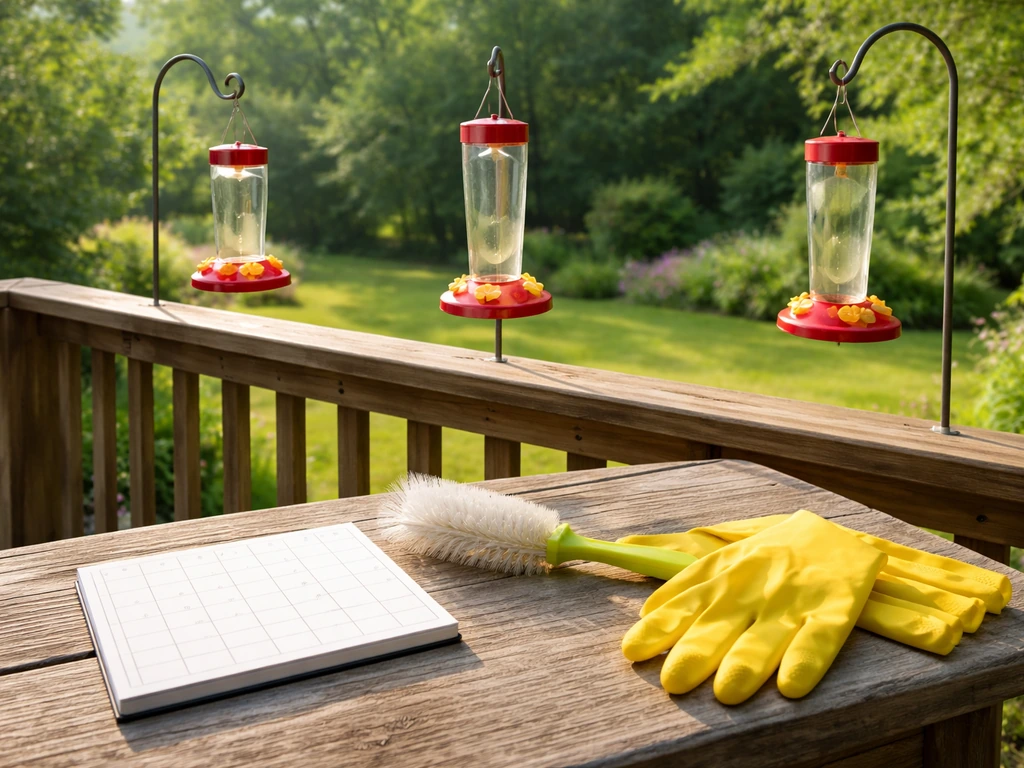
Prevention at hummingbird feeders comes down to three things: cleaning frequency, feeder setup, and reducing crowding.
Cleaning schedule
Iowa DNR recommends cleaning hummingbird feeders every 3 to 5 days as a baseline. In hot weather, that interval shortens. Project FeederWatch puts it simply: clean the feeder every time you refill the nectar. Project FeederWatch also says nectar should be refreshed every two to five days depending on temperature, and if you see cloudy water or black mold you should discard the solution and clean immediately Project FeederWatch puts it simply: clean the feeder every time you refill the nectar.. Flathead Audubon advises never leaving sugar water out more than 2 to 3 days, and changing it daily in very hot weather. If you see cloudy water or any black mold inside the feeder, don't just top it off. Discard the nectar, disassemble the feeder, and clean it fully before refilling.
Feeder setup and spacing
Crowding is how disease spreads fastest. Multiple smaller feeders spread around your yard do less damage than one large feeder that draws 20 birds to the same perch. Cornell notes that the density of birds around feeders is one of the key factors driving avian pox transmission. Spacing feeders at least 10 to 15 feet apart, ideally out of sight of each other, reduces territorial fights and the physical contact that enables disease spread.
Seasonal risk and mosquito awareness
Mosquito season overlaps with peak hummingbird season in most of North America, and since mosquitoes are a documented transmission route for avian pox, that timing matters. Avoid placing feeders near standing water where mosquitoes breed. Empty and refresh birdbaths daily. These steps won't eliminate mosquito exposure, but they reduce it meaningfully.
If you also feed seed or grain birds
If you maintain seed feeders alongside nectar feeders, the two populations do interact, and salmonellosis outbreaks in finches or sparrows near seed feeders can complicate the picture. Keep seed feeders cleaned separately with the same bleach protocol. Delaware Department of Agriculture biosecurity guidance notes that removing all feeders and baths used by wild birds is recommended during active local outbreaks as a risk reduction step, and that applies across feeder types.
Finally, always wear gloves when cleaning feeders, even routine cleanings between sick-bird events. The CDC makes this a standing recommendation for bird hobbyists and feeder caretakers, not just an emergency measure. It takes about 30 seconds and removes a real exposure pathway.
FAQ
If I see one hummingbird with a lesion, should I assume it is avian pox or just an injury?
Most likely it is avian pox if the growth is wart-like and round, especially if it appears near the beak base or around the eyes, and if you notice it on both sides. True collisions usually leave torn or bruised tissue and a more clearly one-sided wound. If you are unsure, take the feeder down and treat the situation as possible pox until you can verify whether additional birds show similar signs.
How long should I stop feeding hummingbirds after I remove a feeder due to suspected avian pox?
Aim for at least several days, and longer if multiple birds were sick. Many state wildlife agencies recommend stopping artificial feeding temporarily, then removing feeders for at least a couple of weeks when sick birds have been present. The exact duration depends on how many hummingbirds you saw with compatible signs, and whether you also had other feeder types in use.
Can I keep using the same nectar by topping it off instead of discarding it?
No. Once nectar sits out long enough to start clouding or developing growths, you should discard it. For suspected disease, do not “top off” old nectar, even if it looks mostly clear. Disassemble the feeder, clean, disinfect, rinse thoroughly, and then refill with fresh nectar.
Do I need to worry about bird flu if I only feed hummingbirds?
Under normal backyard conditions, bird flu risk to hummingbirds is generally low. The concern rises if you are in a migratory corridor or near open water where infected waterfowl are present. If you notice neurologic signs like tremors or sudden death, that is a different pattern than typical avian pox lesions, and you should escalate reporting and contact a wildlife professional.
Should I report a sick hummingbird even if it was only one bird?
It can be useful, especially if you observed compatible clinical signs and you live in an area with active outbreaks. Reporting helps your state wildlife agency track patterns. If you see multiple sick birds, or any sudden unexplained deaths in your yard, reporting becomes more important.
Is gloves-only handling enough, or do I need a mask or eye protection when cleaning?
Gloves are a minimum because they prevent skin contact with contaminated secretions and residue. A mask or eye protection is most helpful if you are dealing with heavy contamination, dried crust on perches, or aerosols during scrubbing, but it is not always necessary for routine cleanings. The key steps remain, avoid touching your face, ventilate your workspace, and wash hands thoroughly after cleaning.
If mosquitoes transmit avian pox, will moving my feeder eliminate risk?
It can reduce risk but not eliminate it. Mosquito exposure often depends on nearby breeding sites and local conditions. Move feeders away from standing water, keep birdbaths refreshed daily, and avoid placing feeders right next to mosquito-heavy areas. During peak season, increase cleaning rigor, since feeder hygiene alone does not fully block mosquito-mediated spread.
Does the type of feeder matter for disease spread?
Yes. Feeder designs that create more crowding or contact at perches can increase local transmission. Use multiple smaller feeders spaced around your yard rather than one large feeder that draws many hummingbirds to the same spot. Spacing feeders so birds cannot easily see and fight over them reduces the close physical interactions that support spread.
I found a sick hummingbird on the ground. Should I try to feed it or pick it up?
Do not attempt to feed it and avoid barehand handling. Use gloves or a cloth barrier to move it only if necessary to get it away from hazards, then contact a licensed wildlife rehabilitator or avian vet. Attempting to stabilize it at home can worsen stress and increase exposure risk.
What should I do if I have other bird feeders running, like seed or suet feeders?
Treat nectar and seed stations as separate systems. Clean seed/suet feeders independently with the same bleach protocol, and do not assume that symptoms seen at your hummingbird feeder are caused by the same issue as outbreaks among finches or sparrows. If local outbreaks are reported, reducing overall feeder use during the active period may be recommended by state guidance.
What information will a wildlife rehabilitator want from me?
Expect to provide timing (when you first noticed symptoms), number of birds affected, which feeder(s) were in use, feeder location and spacing, whether there were cloudy nectar or visible contamination, and any visible lesions or behavioral changes. If you can, describe where on the hummingbird the signs were located (beak base, eyes, bare skin) rather than giving only general “sick bird” impressions.
Can I disinfect a feeder with vinegar instead of bleach if I suspect avian pox?
Vinegar can work as a lower-intensity alternative, but bleach at about a 10% solution (roughly 1 part household bleach to 9 parts water) is the more commonly recommended disinfection approach for feeder biosecurity. If you choose vinegar, use it in addition to thorough washing, and do not shorten soak or rinse times. When disease is suspected, defaulting to the bleach protocol is the safer decision.
Latest on Bird Disease: Symptoms and What to Do Now
Latest bird disease updates: spot key symptoms fast, isolate safely, and know when to call an avian vet now.